


This article is also available in a Dutch translation which includes lots of illustrations. You can find it here: Judge Dredd spiegelt een toekomst waarin de werelden van George Orwell en Aldous Huxley samengaan
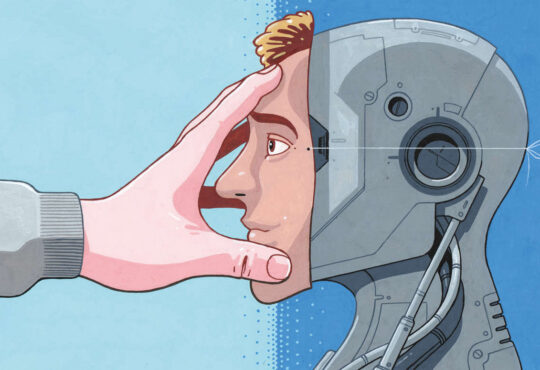
Header illustration by Brian Bolland, © Rebellion
Comic‑book heroes often function as modern myths, reworking older narratives while responding to the political and social anxieties of their time. The Hulk, created by Stan Lee, is frequently interpreted as a modern adaptation of the Golem from Jewish mythology [1]—a figure designed for protection but capable of uncontrollable destruction. Superman has similarly been read through mythological lenses, with scholars identifying echoes of both the Golem and the biblical story of Moses.[2] An even clearer historical parallel appears in Captain America, who emerged during the Second World War as a symbolic response to fascism and Nazism.
In a comparable way, Judge Dredd too references the Golem, born in the United Kingdom of the late 1970s—a period marked by economic crisis, social unrest, and growing anxiety over crime and disorder. The character rose to prominence alongside the ascent of Margaret Thatcher and the spread of conservative political ideas emphasizing “law and order,” market domination, a discourse of discipline, and strong authority.
These themes resonated with broader neoliberal currents often associated with thinkers such as Friedrich Hayek, who stressed the primacy of order, market rationality, and strict limits on collective intervention, arguing that the state should concern itself only with law and order: the free market needed protecting to ensure it ran smoothly, and only then could true “freedom” be found.[3] Hayek’s admiration for General Pinochet’s authoritarian free‑market regime in Chile became emblematic of a worldview in which law primarily protects markets and property rather than citizens’ rights.
Within this political climate, Judge Dredd made sense. While superhero narratives traditionally draw a clear line between good and evil, and their protagonists ultimately aim to protect people—Superman, for example, first fought corruption and social injustice before battling aliens—for Judge Dredd, preserving order comes first. He is a human clone, biologically engineered for a single purpose: to enforce the law of Mega‑City One at any cost and thus ensure continuity, predictability, and absolute fidelity to the system. He presents an extreme vision of governance: a future in which legal authority is collapsed into a single figure who acts simultaneously as judge, jury, and executioner, turning the mythic hero into an instrument of systemic control rather than liberation.[4] Justice is no longer deliberated; it is executed. Conscience is no longer exercised; it is designed out of existence.
Two Dystopian Worlds Meet in Mega‑City One
As Michael Molcher argues in I Am the Law, the series anticipated the hardening logic of modern “law and order” politics—from zero‑tolerance policing and the violent suppression of protest to the steady expansion of the surveillance state, resonating the dystopian world of George Orwell’s 1984 [5]. But Judge Dredd is not merely Orwellian. While Mega‑City One is saturated with surveillance and coercion, it also reflects a distinctly Huxleyan logic of biological and psychological conditioning. In Aldous Huxley’s Brave New World, social order is secured not primarily through terror, but through design: human beings are engineered, categorized, and conditioned to accept their place in a system optimized for stability. Individual conscience is replaced by programmed loyalty.
Mega‑City One thus stands at the intersection of Orwell and Huxley: a society governed both by surveillance and by systemic conditioning, where humans increasingly resemble machines and machines assume the role of human judgment. Judge Dredd himself embodies this fusion.
The comics offer a dystopian world that functions as a kind of black mirror set just ahead of us in time: a future where the borders between humans and robots blur, the separation of powers and other democratic pillars disappear, heroes and anti‑heroes lose their conventional meaning, people become increasingly isolated in a “lonely crowd,” absurd laws echo our present, and most are pushed into mere survival amid a permanent state of crisis.
Rob Weiner, a popular culture librarian and expert on comics, explains in an email that “anyone who disrupts the system is the villain in the Judge Dredd universe. The needs of the many outweigh the needs of the one for the sake of order. The individual is not a consideration as long as the system as a whole is working. It is a system‑based villainy where if one tries to go against the system they are punished. Individuality has no place in this system‑based totalitarian government of Judge Dredd. This results in a form of system‑based totalitarianism, where dissent is punished not because it is immoral, but because it is inefficient. Justice becomes whatever the state requires at any given moment.
Protest and Revolt: “Democracy Is Not for Citizens”
Across the Judge Dredd stories we can see at least three waves of protest and revolt. First, there are fragmented and often futile conflicts in which isolated and marginalized groups turn against one another rather than against the system itself—separate blocks or communities attacking each other while the Judges maintain control.
A second wave appears in stories such as “America,” where a pro‑democracy movement—the “Democracy” or “democracy tendency” campaign—tries to challenge the Judge system without resorting to violence, demanding that power be returned to the people and that Judges be made accountable rather than ruling above the citizens. When one group of activists occupies a TV studio in order to broadcast a message of democracy, Dredd leads the assault that kills them and ends with his chilling conclusion that “democracy is not for the people.”[6]
A third wave emerges when some robots begin to feel pain, develop self‑awareness, and rebel against exploitation, as in the early “Robot Wars” arc and later stories that frame robot uprisings as a kind of slave revolt—an attempt to finally say “enough” to being the slaves of “these fleshy humans.”[7]
Alongside these revolts from below, the series also shows failed challenges from within the system itself: Dredd’s own clone‑brother Rico becomes a rogue Judge, embodying the possibility—and the danger—of internal dissent.
In one democracy‑themed storyline, undercover Judges stage provocations and manipulate public perception—conducting operations that resemble “false flag” attacks and framing democracy activists as dangerous extremists. This strategy recalls investigative journalist Trevor Aaronson’s book The Terror Factory, which documents how the FBI built a vast network of informants to infiltrate Muslim communities and, in some cases, manufacture phony terrorist plots that could later be “foiled” as proof of success in the war on terror.[8]
Fighting the democracy tendency in Judge Dredd thus involves not only brutal force on the streets, but also disinformation, blackmail, and the weaponized use of data the Judges hold on citizens.
Data, Power, and “I Am the Law”
Data monopolization and misuse to obtain and maintain a grip on power are of course not limited to the world of Judge Dredd. In his book The Data Grab, Nick Couldry, author of The Data Grab and professor of media and communications at the London School of Economics, describes how Big Tech extracts and exploits our personal data, comparing this misuse to a form of modern colonialism. In an email he explains how his main worry is not the monopolization of data—for that has already happened—but the monopolization of the faculty of judgment by machines and the corporate tech that runs those machines. Power relations that will likely develop even faster as the adoption of AI progresses.
Couldry warns that by generalizing judgment capacities and judgment resources – which could be a result of allowing AI into the courtroom – across institutional boundaries, we risk undermining the distinctive forms of human or human‑related expertise on which institutional purpose and legitimacy are based. The very idea of separation of powers rests on distinct forms of human expertise associated with different institutions, but with AI we risk undermining the cognitive resource on which that institutional separation is constructed.
If law becomes a direct output of data‑driven systems, legality itself risks becoming automated and arbitrary. When Dredd declares “I am the law,” interpretation, enforcement, and legitimacy collapse into a single authority. Justice becomes something enforced rather than reasoned, computed rather than debated.
In Judge Dredd, even the Judges themselves, though still human and “bio‑creatures” like Dredd, appear as a transitional stage: the final step before human decision‑makers can be removed altogether and replaced by fully automated, machine‑based judgment.
Judge Dredd, AI, and the Future of Justice
Keri Grieman, a technology‑law researcher at the University of Oxford, notes in an email that pop culture like Judge Dredd shapes how we imagine the future of justice systems [Judge Dredd vormt ons toekomstbeeld], but it also reflects our existing, well‑grounded fears about where those systems may be heading [Ons toekomstbeeld vormt Judge Dredd]. She points out that some judicial processes do not involve intricate decision‑making and could, in principle, be automated relatively simply—for example, no‑fault divorce procedures that merely certify uncontested applications, or pleading guilty to something relatively binary like a parking ticket. At the same time, she reminds us that there are already concerns about “judge‑made law”: in common‑law systems, judicial precedent effectively defines justice and legal norms, but is not always clearly grounded in democratic processes. A shift to AI tools could reproduce these problems or even entrench them more deeply, especially when systems are trained on historical data. AI carries its own specific risks, yet it also mirrors and magnifies existing flaws.
Grieman adds that Judge Dredd is less a metaphor for algorithmic governance in a narrow sense than a broader warning about democracy and human rights. The condensation of power into a single, powerful, opaque entity—answerable to no one—embodies fears of authoritarianism in general, with a particular emphasis in the Judge Dredd canon on police brutality. In this light, the figure who declares “I am the law” looks uncomfortably close to an unaccountable system, whether human or machine, that enforces order without explanation or consent.
Morality Without Free Will
In an age of “Homo Deus” and fantasies of a machine‑ruled era, Judge Dredd cannot be evaluated according to conventional moral standards, because morality presupposes free will and ethical choice. Dredd possesses neither. Conditioned from birth and trained to suppress personal judgment, he functions less as a moral agent than as an extension of the system itself.
This is precisely what makes Dredd appear, at times, as a “great hero.” He is incorruptible, immune to favoritism, and applies the law uniformly. Equality before the law is achieved not through compassion or justice, but through mechanical consistency.
Yet this same quality reveals the authoritarian logic of Mega‑City One. Dredd explicitly rejects revolution and democracy as legitimate options for citizens. Political participation and dissent are framed as threats rather than rights. Law ceases to express popular will and becomes an end in itself.
Dredd thus embodies a central paradox: absolute fairness in enforcement coexists with the total negation of political freedom. Justice becomes procedural rather than moral, and obedience replaces consent—an ideal framework for post‑human or AI‑driven systems optimized for order rather than human dignity.
Useless Class
In an apocalyptic world where the separation of powers disappears and machines and robots are omnipresent, a huge number of citizens are not only marginalized but become a burden in the eyes of those who govern. We learn about unemployment rates more than 90 percent in Mega‑City One, a nightmare that echoes one of the worst scenarios in AI doomsday prophecies creating what Yuval Noah Harari calls the “useless class.”
The social world of Judge Dredd is defined by sharp divisions—between citizens and non‑citizens, the employed and the unemployed, and the governed and those who govern. These divisions closely mirror real‑world anxieties surrounding immigration, economic precarity, and the concentration of power. In an interview, Dr. Pritesh Chakraborty, Assistant Professor of English at Maharaja Srischandra College, offers valuable insight into how these themes operate within the Judge Dredd universe.
Dr. Chakraborty emphasizes in an email that the rigid social divisions in Judge Dredd reflect real‑world “us versus them” dynamics. Scapegoating, particularly of immigrants, emerges as a familiar mechanism through which societies displace blame for systemic failures: “The writers of the series have acknowledged that one of the main sources of crime in the Megacity is unemployment (as high as 99%). Bored youth often channelize their energies through daring acts of defiance and thus run foul of the judges. These issues are ever present in the stories and are the chief butt of ridicule against the society.”
Such tensions are not incidental but are central to the narrative’s social critique, frequently serving as objects of satire.
People are separated into blocks. As Michael Molcher emphasizes in his book I Am the Law, the number of walls in the real world has exploded—from just a handful of physical border walls to at least sixty‑three by 2020. [9] In one part of the world, countries build walls to “protect” themselves from immigration and refugee waves (the United States vs. Mexico) or war (Finland vs. Russia). But separation also takes place within societies, as French president Emmanuel Macron has called “séparatisme,” where communities or suburbs create their own rules.
Finally, Dr. Chakraborty situates Judge Dredd within a broader critique of corporate power. Echoing dystopian visions articulated by writers like Philip K. Dick, the series portrays a world in which corporate logic supersedes democratic governance. Judge Dredd repeatedly hints at the dystopian consequences of unchecked capitalism and total corporatization. The Judges themselves—who operate simultaneously as police, judge, jury, and executioner—embody a form of institutional multitasking that mirrors modern corporate practices. This consolidation of authority, Dr. Chakraborty argues, often leads not to efficiency but to catastrophic error, exposing the inherent dangers of concentrating power within a single, unaccountable system.
Human beings in this system are dehumanized by Mega‑City One, where people are “parked” into blocks, unemployed and trapped in survival mode, losing any sense of meaning in their lives. There is no horizon of change within this repressive system. In one story mentioned in I Am the Law, when a person is condemned to forced labour, he is happy because at least he has something to do.
Mythic Judges in a Machine Age
Before turning to its mythological roots, it is important to note a defining feature of Judge Dredd: its pervasive brutality. Unlike many dystopias built on surveillance or control, Mega-City One enforces order through overt violence, with Judges embodying the law through force. This raises a key question—why is justice so explicitly violent? The answer lies not only in political systems, but in older archetypes of the judge as a warrior-deliverer rooted in myth and religion.
The mythological dimension of Judge Dredd, as explained in the beginning of this article, becomes clearer when placed alongside the Book of Judges. In response to a question about these mythic resonances, Aaron Welty—a cultural commentator and motivational speaker who has written on superheroes and mythology for the C.S. Lewis Institute—offers a helpful summary of how the biblical “judges” should be understood. He explains that, unlike the modern image of a judge who “sits within the confines of court chambers,” the judges in the Book of Judges were fundamentally martial figures: military leaders first and lawkeepers second. Drawing on C.S. Lewis’s Reflections on the Psalms, Welty notes that these figures might better be described as “champions.”
Lewis writes: “The Divine Judge is the defender, the rescuer. Scholars tell me that in the Book of Judges the word we so translate might almost be rendered ‘champions’; for though sometimes these ‘judges’ perform what we would call judicial functions many of them are much more concerned with rescuing the oppressed Israelites from Philistines and others by force of arms. They were more like Jack the Giant Killer than a modern judge in a wig.”
Welty adds that this interpretation is reinforced by the ESV New Reformation Study Bible, which explains: “The term for ‘judge’ is not used in the sense of one who decides court cases but of one who delivers from injustice and oppression. The primary task of a judge is military in nature. The bulk of the material in the cycle of judges focuses on the military deliverance of the judges.”
Welty then turns to Gregory Pepetone’s essay “Pulp Heroes in the Shadow of God” (in The Gospel According to Superheroes) to show how this reading of Judges connects to modern heroic narratives. Summarizing Pepetone, he notes: “According to the book [of Judges], God would raise up shophetiym, a Hebrew term often translated as ‘judges’ or ‘one who brings justice,’ to deliver ancient Israel from oppressive enemy states that bordered it. Depending on how much these deliverers relied on the moral authority of God instead of themselves or patriotic nationalism, they would either become vigilantes who took the law into their own hands or charismatic rulers who reigned not by dynastic entitlement but by a divinely conferred spiritual grace. In other words, they were faced with a choice of first allegiance. They could either be led by God’s moral direction or trust in themselves and their national pride.”
Pepetone continues: “In many ways, Israel’s ancient tribal legends associated with the judges from Othniel to Samuel contain all the elements of pulp fiction thrillers. We find a melodramatic universe inhabited by victims, good guys, and sheer baddies, a plethora of sensationalized incidents, and a fast‑paced narrative that maximizes action at the expense of ethical or psychological nuance. Above all, we find an implicit code of vigilante justice premised on the heroic deeds of individuals who have no qualms about using violence and treacherous means in the service of noble ends… the heroes of the gothic imagination, in classical as well as pulp fiction, not only exhibit latent antisocial tendencies but also become complementary opposites of their enemies, representing a metaphysical dyad. While at a conscious level they seem impervious to the villainy they oppose, at a deeper level they are bound to their nemesis in an almost symbiotic relationship.”
Taken together—through Welty’s use of Lewis, the New Reformation Study Bible, and Pepetone—these assessments suggest that the Book of Judges and the pulp fiction tradition, represented by figures such as Doc Savage, The Shadow, and Conan the Barbarian, share a structural archetype: the “judge” or champion as a martial deliverer operating in morally heightened, action‑driven narratives where justice is enacted through force.
Judge Dredd represents a late‑modern mutation of this archetype. The ancient deliverer, once grounded in divine mandate, and the pulp vigilante, driven by individual charisma, are both reconfigured within a bureaucratic and mechanised state apparatus. In Dredd’s world, the champion no longer answers to God or personal conscience but to the system itself. The mythic judge survives—but now as an instrument of institutional power in a machine age.
Stranger Than Fiction: Absurdity of Laws
In Judge Dredd: America, citizens of Mega‑City One live under a maze of absurd laws and disproportionate punishments. The protagonist of the “democracy tendency” begins to question whether her child should grow up in a city where any trivial infraction can trigger devastating consequences. The stories often read as exaggerated satire—until we look at today’s headlines, where reality can feel stranger than fiction. Recent years have seen people arrested or prosecuted over social media posts, especially in the UK [10]; individuals publicly shamed and handcuffed for minor infractions such as feeding pigeons [11]; children detained by ICE in the United States [12]; and a deportation order for an eight‑month‑old baby that shocked Sweden [13]. Such examples show that legal absurdity is not just about controlling and repressing people; it also cultivates a pervasive atmosphere of fear.
Under these conditions, people learn to censor themselves in advance, narrowing their own behaviour long before the state intervenes. Law is officially justified as protecting citizens, but in practice it often narrows their horizons, particularly for foreigners and marginalized groups who can be blindsided by sudden enforcement.
In Judge Dredd, the Judges enforce these absurd laws with unwavering zeal, yet the comics also suggest that their existence is rooted in the failure of democracy itself. Dredd is both a symptom and a justification: his presence is legitimated by the claim that ordinary political mechanisms have collapsed. At the same time, he possesses one quality that many contemporary systems increasingly lack: a harsh, almost mechanical impartiality across social classes. This combination—failed democracy, arbitrary laws, and rigorously unequal power wrapped in formally equal enforcement—makes Mega‑City One an unsettling mirror for our own debates about security, rights, and the rule of law. Increasingly, Judge Dredd feels less like satire and more like a preview of our future.
Conclusion
The world of Judge Dredd presents a disturbing yet familiar vision of the future—one shaped by automation, mass unemployment, and the gradual dehumanization of social relations. As artificial intelligence increasingly governs labour, law, and decision‑making, the emergence of what Yuval Noah Harari describes as the “useless class” becomes less speculative and more imminent. Mega‑City One, with its vast unemployed population and rigid systems of control, functions as a warning rather than a fantasy.
As Rob Weiner says in an email: “There is a lot of negative speculation about how AI is going to change the world. As technology changes so does the world. There could be a possible future where democracy has no place and everything and everyone is under surveillance by an AI. We already live in a world where surveillance is everywhere and that could keep growing. We are not at the point yet where a situation like in Mega‑City One is dominating our lives. One of the things science fiction does is give us possible scenarios for the future and Judge Dredd fits into that possibility.”
Judge Dredd appears as a satire filled with absurd laws and punishments beyond imagination, but in our own supposedly democratic societies, absurd news stories multiply—such as rising arrests of citizens in the UK over their social media posts, which sometimes even outstrip practices in authoritarian countries, or the detention of children by ICE in the US, or a government granting asylum to parents while denying it to their one‑year‑old child. The gap between fiction and reality narrows. What once appeared as dystopian exaggeration now reads as cultural foresight.
Judge Dredd himself appears as a solution to many human failures: corruption, inefficiency, and vulnerability. His incorruptibility and mechanical fairness promise stability in a chaotic world. Yet this solution comes at a cost. By eliminating moral judgment, political agency, and dissent, Dredd embodies a system in which justice is reduced to procedure and obedience replaces democratic participation.
In this sense, Judge Dredd anticipates a post-human order reminiscent of Homo Deus and the final scene of Animal Farm, where the distinction between humans and machines becomes increasingly blurred. At the same time, the divide between rulers and ruled is not erased but intensified: those who enforce the law stand entirely apart from those who must obey it. The question the series ultimately leaves us with is not whether such a future is possible, but whether humanity can retain ethical responsibility and dignity in a world governed by systems designed solely for efficiency and control.
AI got the blame for the Iran school bombing. The truth is far more worrying (The Guardian). A long read about how AI, both classical and modern variants, were and are being used on the battlefield. Within that context many of the ethical and judicial deliberations and problems discussed in the above article also play an important part.
- Petrossian, F. (2025) ‘The Golem: a mythical protector inspiring US comics, but also a metaphor for AI’, Global Voices, 8 February. Available at Global Voices
- Jewish Museum of Switzerland (2023) ‘Superman is a Moses adaptation’, Jüdisches Museum of Switzerland. Available at the Jüdisches Museum of Switzerland
- Molcher, M. 2023. I Am the Law: How Judge Dredd Predicted Our Future. Rebellion, p. 32–33
- Whyte, J. 2023. Neoliberal Economists Like Milton Friedman Cheered on Augusto Pinochet’s Dictatorship. Jacobin, 11 September 2023. Available at Jacobin
- I Am The Law: How Judge Dredd Predicted Our Future – out now!, 2000 AD (22 February 2023). Available at 2000 AD
- Wagner, J. and Ennis, G. 1991. Judge Dredd: America. London: Fleetway.
- Weatherly, S. 2021. ‘Do Robot Judges Dream of Electric Perps?’, in Judging Dredd: Examining the World of Judge Dredd, ed. S. Weatherly. Edwardsville, IL: Sequart Organization, p. 59
- Aaronson, T. 2013. ‘Inside the Terror Factory’, Mother Jones, 11 January 2013. Available at Mother Jones
- I Am the Law: How Judge Dredd Predicted Our Future (Molcher, M. 2023) I Am the Law: How Judge Dredd Predicted Our Future, Rebellion, p. 89
- Forbes, S. 2025. ‘People Are Being Thrown in U.K. Prisons Over What They’ve Said Online. Can Free Speech Be Saved?’, Forbes, 9 September 2025. Available at Forbes
- Metro. 2026. ‘Woman arrested and fined £100 for throwing bread on the ground to feed pigeons’, Metro, 10 January 2026. Available at Metro
- Woodward, A. 2026. ‘Heartbreaking letters reveal the reality for children detained by ICE: “I have never felt so much fear”’, The Independent, 9 February 2026. Available at The Independent
- O’Mahony, P. 2026. ‘Deportation order for 8-month-old baby shocks Sweden’, The Local, 21 February 2026. Available at The Local