



Dit artikel is een Engelse vertaling. Het Nederlandstalige origineel vind je hier.
Once upon a time…
Jona diving into the nightlife in Het Amusement (The Entertainment). The worker in White Collar being swept along in the capitalist rat race. Big Panda travelling through the spiritual world in Big Panda and Tiny Dragon. Three completely different characters, three completely different visual narratives. And yet, they share something: each of them undergoes an inner transformation. You feel that through their emotions – but just as much by the way time is depicted. Time is one of the most powerful tools a creator has to make a reader feel something. And its impact is greater than you might expect. In my research, I identified eight ways in which the representation of time influences the reader.
Time is present in every story. Even a single panel takes time to read. Time can be the subject of a story, it can set the mood, or it can seem almost invisible. As Kelly Bender writes in her insightful article on time in comics: “what all comic books have in common is time. And not just time, but the passage of time.”
Filmmaker Christopher Nolan – whose films often revolve around time – calls time ‘the most fundamental part of our human experience’. According to him, the way we perceive the world is shaped by time. I share that belief, and I would add: time largely determines how we experience a story.
Time, the creator and the reader
Because time is so decisive, it becomes fascinating for a creator to consciously play with it. That fascination gripped me, and I wanted to explore it. I began by diving into film theory, since film – like visual narratives like comics – depends on time. But there are also important differences between film and comics. Where a film viewer surrenders to the maker’s pacing, a reader of a visual narrative sets his own tempo: pausing, flipping back, even peeking ahead – it’s all possible. And then there is the gutter, the space between panels. In film, transitions are unobtrusive; in comics, the gutter is a powerful tool for conveying the passage of time. Kelly Bender writes: “the gutter holds ‘frozen moments of time’.” Whether time within a single panel is truly frozen, I’m not so sure; later on I’ll show an example of time unfolding within a single image.
Eight effects of time
In my extensive analysis of twelve visual narratives, I discovered eight ways in which time affects the reader. Below is a brief introduction with examples. At the end, I explain the analytical model.
Chronological time: a tool for keeping stories moving logically
In large, plot-driven stories, it is helpful when time progresses smoothly, logically, and unobtrusively. Creators often use a chronological structure and clear time jumps to achieve this. Scott McCloud calls action-to-action sequences ideal for this purpose: “[they are] known for their efficiency.” The effect is that the reader is drawn into the story without being distracted or confused by the passage of time.
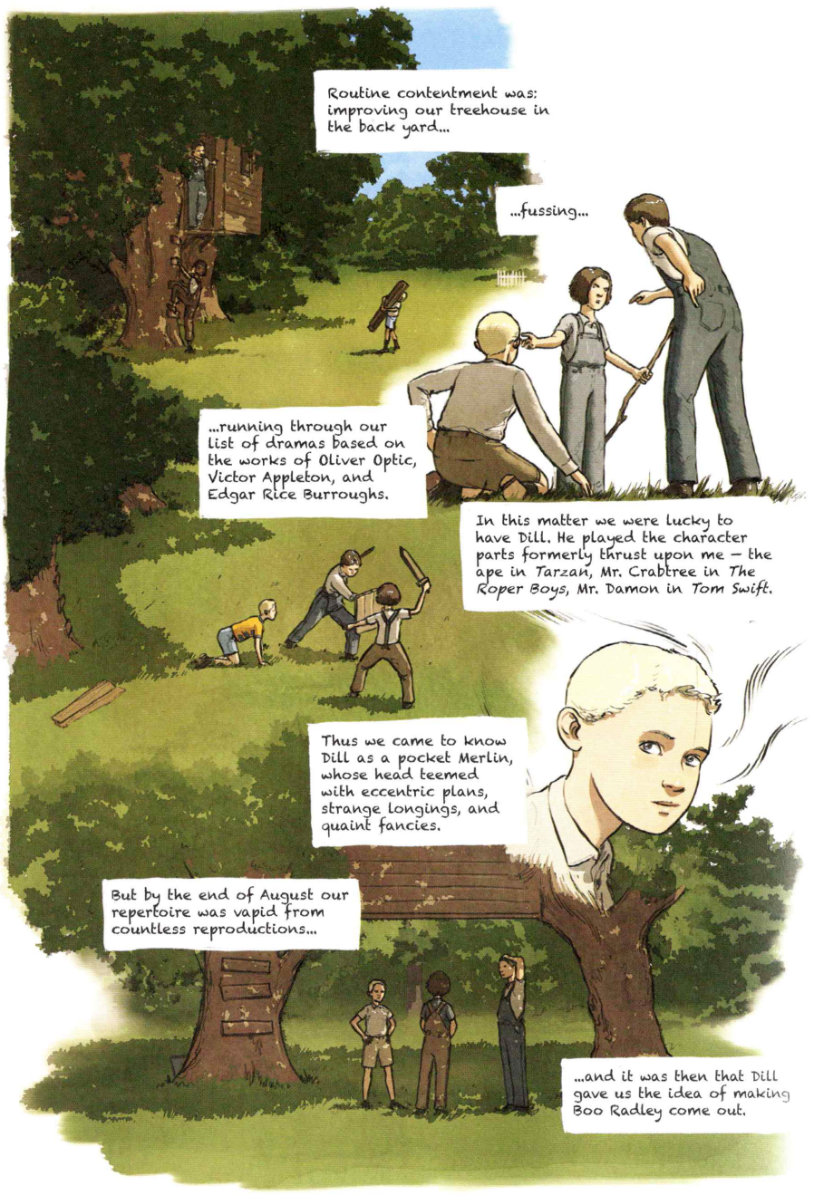
A good example is the graphic adaptation of To Kill a Mockingbird. The story spans more than two years (1933–1935) and is told in a classic manner, without conspicuous stylistic devices. A flashback is clearly distinguished in style – often through a different colour palette – so it doesn’t confuse the reader. Time flows naturally through the seasons: evening light shows the day coming to an end, bare winter trees give way to summer foliage. The text also supports the chronology in a logical way, with lines such as ‘autumn turned to winter that year’ and ‘summer was on its way.’
Historical time: sketching a believable past
To show that a story takes place in a specific historical period, a creator can use recognisable stylistic elements from that era: photographs, newspaper headlines, media, colours. The effect is that the depicted period feels accurate and authentic to the reader.
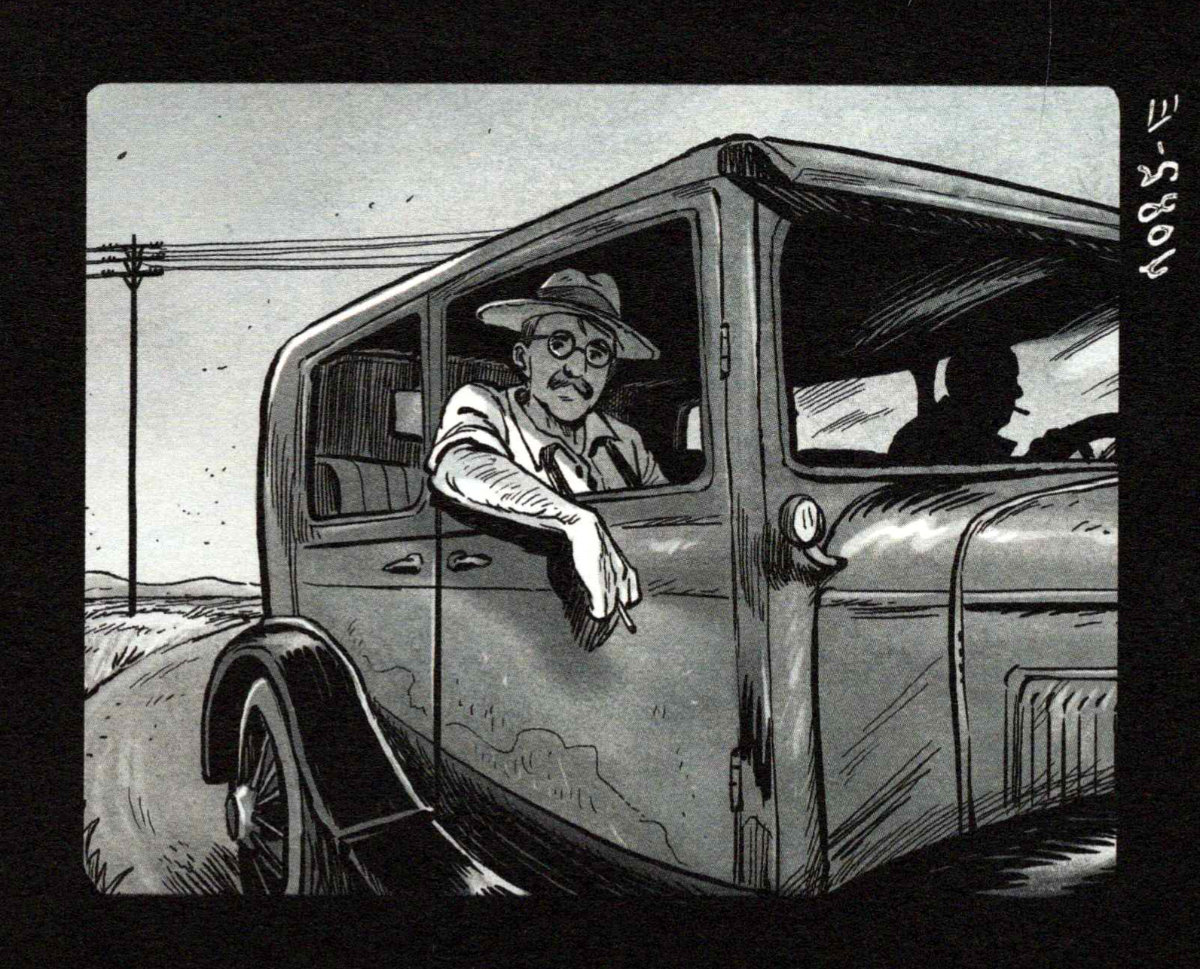
Aimée de Jongh does this in Days of Sand. The fictional photographer John travels to the Dust Bowl in 1937, to document the situation on behalf of the government. Original black-and-white photographs open each chapter, and the images John takes resemble the famous Dust Bowl photographs by Dorothea Lange from the 1930s.
De Jongh also refers to well-known images in her journalistic work. In Europe’s Waiting Room, her drawn report on the 2015 refugee crisis, she recreates the news photograph of the drowned toddler Aylan Kurdi – an image that became a symbol of the crisis. By drawing it literally, she transports the reader straight back to that moment in time.
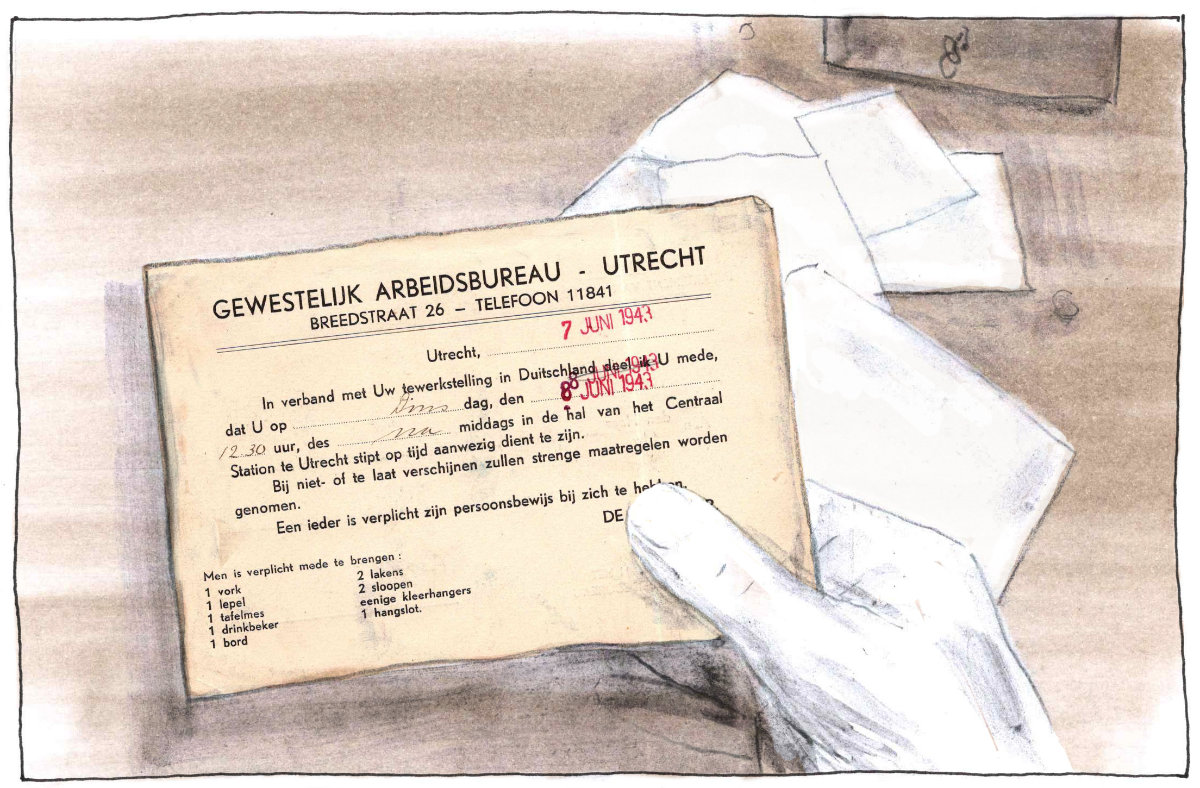
In Het zwijgen van Jaap (Jaap’s Silence), I used original documents and newspaper clippings to reinforce authenticity and emphasise that the story is based on real events.
Alternative time: what characters dream of or fear
Time does not always have to be accurate or chronological. Creators can also show an alternative time – time as characters dream it, or time they are afraid of. A ‘what-if’ timeline, with the effect that the reader becomes aware that history could have unfolded differently.

In the authorised graphic novel Anne Frank’s Diary, Anne’s fantasies about the future are drawn out. She imagines what her life will look like after the war, and even how scientists in the year 3001 will look back on this war. The creator in a way breaks out of the time of the Secret Annex (het Achterhuis). He shows the future as an alternative course of history. These scenes are heartbreaking precisely because we, as readers, know that Anne will never live to see that future.
Suspended time: slowing down to emphasise a specific aspect
Sometimes time is slowed down or even brought to a standstill. This can be done by repeating a particular action or parts of that action. This aligns with what Scott McCloud calls aspect-to-aspect transitions, which he describes as a suitable way to ‘freeze’ time: “[it] creates a strong sense of place and mood.” The effect on the reader is that a particular aspect of the story receives extra emphasis.
In White Collar, there are sequences that show the monotony of the worker’s daily life: working, commuting, coming home. But also sequences about dismissal, poverty, and recovery. This repetition highlights the treadmill of capitalism.
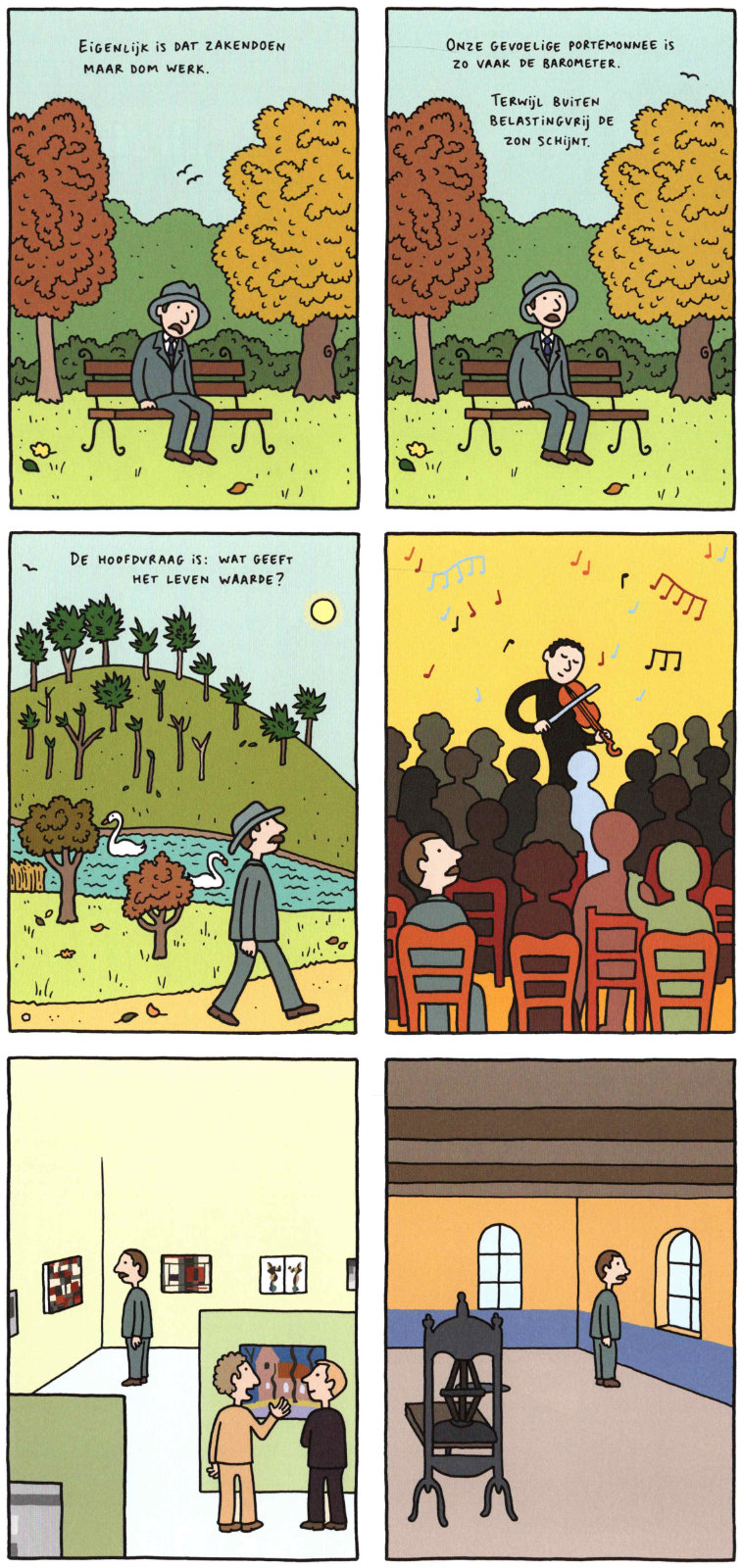
Literal repetition of events also works well to spotlight a particular aspect. This happens in De Omslag (The turning point) by Barbara Stok. The book covers a crucial period in the life of the renowned printer Hendrik Nicolaas Werkman. One of the most beautiful moments is the ‘musing scene’, in which Werkman reflects on the meaning of life across several panels: we see him walking in the park, at a concert, in a museum, and staring out of a window. As a reader, you feel that Werkman has been brooding for days, which underscores the build-up to his artistic breakthrough.
In Het Amusement (The Entertainment), Brecht Evens uses suspended time to visualise doubt. Jona hesitates about whether to go out on the night before his move; that hesitation is captured in a single panel filled with successive mini-events. Later, the act of ‘going out’ is shown in one large drawing of the stairwell, surrounded by the lives of others. His decision to leave his apartment gains extra weight as a result. And when Jona’s ‘friend’ Buzz later hits someone with a chair during a bar fight, the movement is slowed down through three consecutive images, increasing the impact.

Asynchronous time: creating tension through time
As a creator, you can delay the showing of an event or present several events simultaneously. Split screens, cross-cutting, or flash-forwards are common tools for this. They allow you to play with what the reader knows: sometimes the reader knows more than the character, sometimes less. The effect is tension. Think of the classic ‘Punch and Judy’ effect: “Watch out, behind you!”
In Anne Frank, we see life in the Secret Annex and, at the same time, the police searching the house – shown in a split screen. Only the reader sees this simultaneity, which creates suspense in the scene. It makes the story of Anne Frank – of which every reader knows the ending – feel tense nonetheless.
In Days of Sand, Aimée de Jongh builds tension through subtle foreshadowing. When photographer John leaves New York, the reader already knows his destination: Oklahoma. We saw it in the opening scene, where John wondered, “How did I end up here?” The long travel sequence – eleven pages in which landscapes shift and John crosses multiple state borders – creates suspense: as readers, we know what he will encounter, but John does not. Unlike the reader, he cannot look into the future. The line ‘Death lived here’ heightens that tension.

Accelerated time: making the passage of time tangible
A creator can show time passing – literally – by depicting characters aging, trees growing, or objects changing. The effect is that the reader feels life moving on and generations shifting. Accelerated time often evokes melancholy.
In Father and Daughter by Michaël Dudok de Wit, the story spans eighty years. A girl returns, at every stage of her life, to the place where she last saw her father. The place stays the same, the seasons change, and the girl grows into an old woman.
In Anne Frank, time becomes tangible through objects: a comb losing its teeth, sheets wearing thin, the father’s tie eaten by moths, Margot’s bra becoming two sizes too small. Together, they show – within a single page—that a year has passed.
In Het zwijgen van Jaap, I let a decade pass in the final scene by showing Jaap visibly older and smaller in a single image.

Cyclical time: the story as a circle
Cyclical time also involves accelerated time, but here the story ends exactly where it began. Time does not move from a. to b., but from a., through b., back to a. Time passes palpably, and the effect is that the reader experiences life as cyclical.

In the story Old Aspen (from Metsänpeitto), the Christianisation of Finland is told across thousands of years. Images return; beginning and end resemble each other. The growth of trees – above and below ground – shows vast stretches of time in a single image. Nature takes its revenge and proves resilient and cyclical.
Inner time: making an inner development visible
The passage of time can also be used to reveal the inner life of characters. This can be done in many ways, often emphasising the choices characters make – or fail to make – at crucial moments. In other words: whether they seize the ‘inciting moment’ to change their lives. As Robert McKee writes: “Character-driven stories put major events in the character’s hands. In these tellings, the choices and actions the characters make and take cause what happens. Not chance, not overpowering global or natural forces, but personal choices, powered by free will, drive the telling.” The effect is that a character’s inner development – sometimes literally depicted as a journey – becomes palpable to the reader.
In Big Panda and Tiny Dragon, the physical journey of the title characters symbolises a mental one. Repetition and shifting landscapes create an almost meditative effect.
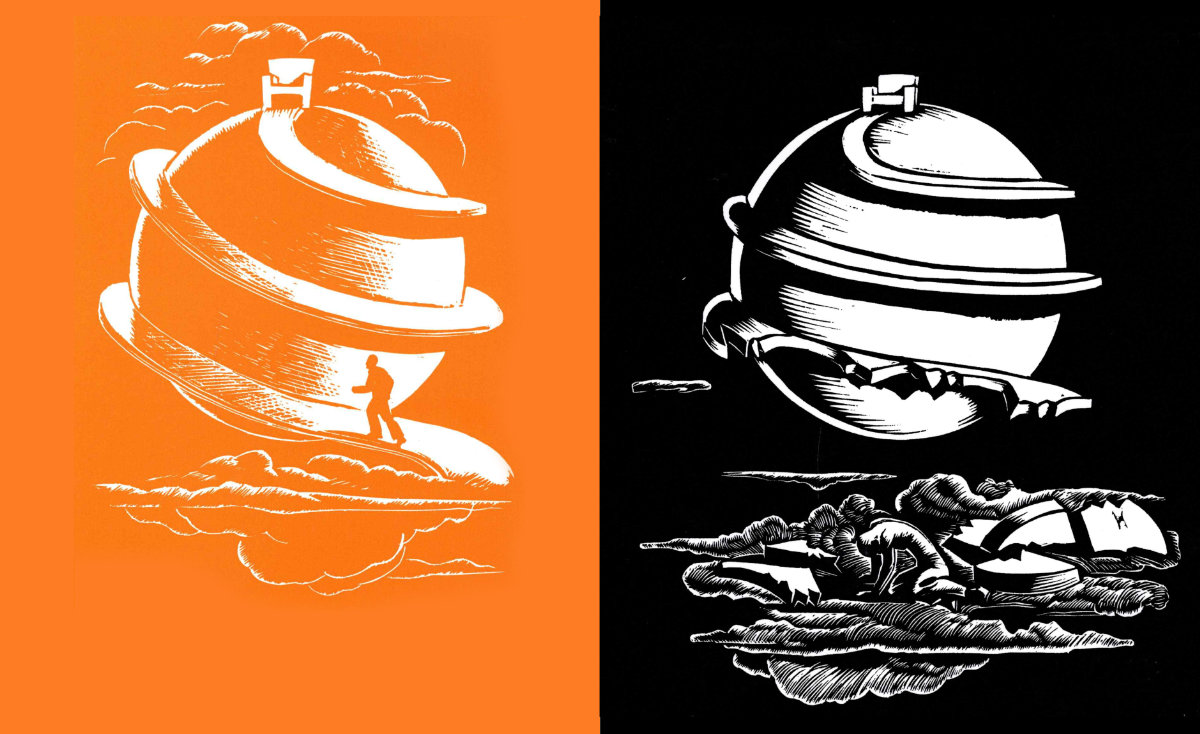
In White Collar, the worker’s growing awareness is central. This becomes tangible in a storyline where a man climbing toward ‘the top’ ascends a crumbling globe – and eventually tumbles off.
Jona also undertakes an inner journey in Het Amusement (The Entertainment). The story is fragmented and intoxicating; time is the only anchor as night turns into morning. Cross-cutting, acceleration, and deceleration keep the reader close to the characters. The question is not only when and how the night ends, but whether Jona – and the other protagonists – make the right choices: can Jona repair the damage of the night and reach his new life in Berlin on time? Can Rodolphe quiet his mind? Will Victoria manage to free herself from the meddling of those around her?

The analytical model
I began my research by analysing the role of time in twelve visual stories. My starting point was David Bordwell’s Narration in the Fiction Film. I’ll summarise his extensive theory here very briefly and in my own words. Bordwell focuses primarily on the role of the viewer: how he actively constructs meaning based on the ‘cues’ he is given. Bordwell distinguishes three components in film narratives:
- Content of the story (fabula): the events.
- Plot structure (syuzhet): how those events are presented in time.
- Style: the use of the medium’s expressive tools.
For readability, I use the terms Content, Plot structure, and Style. Plot structure and style together form the narrative discourse. Narrative discourse can play with logic, time, and space, and can deliberately leave gaps for the viewer or reader to fill in. Think of the leap from a princess’s birth to her eighteenth birthday. The reader understands that jump effortlessly, based on it’s knowledge of the world and of certain genres and styles.
It is striking that Bordwell analyses ‘time’ primarily at the level of Plot structure, emphasising three aspects:
- Order: the sequence in which events are shown – through flashbacks, flash-forwards, split screens, etc.
- Frequency: how often something is shown.
- Duration: how long an event is stretched out or condensed.
When I began analysing stories through the lens of time, I found Bordwell’s focus on Plot structure too narrow. I therefore expanded my analytical model to include the levels of Content and Style as well. For this, I drew on my own findings as well as other theorists. Scott McCloud, for example, shows how powerful the panel can be: the jump between two panels can represent a fraction of a second – or millions of years. As long as the reader understands it, it remains plausible.
I also added an overarching category to the model, which I call Intertextuality: signals about time that only work if the reader possesses certain historical or cultural knowledge. They enrich the story for those who are familiar with this knowledge, but ideally they are never a deal-breaker. I did not find a single example in which the passage of time became unclear due to a lack of prior knowledge.
A toolbox for creators
The eight effects of time I described strike me as fairly universal. They appear across many types of visual narratives: fiction and non-fiction, traditional and more experimental storytelling. That is why I found it useful to turn the analytical model into a kind of toolbox for creating visual stories.
It helped me while making my book Het zwijgen van Jaap (Jaap’s Silence). It allowed me to play with time more consciously and to use different effects – both to let the story unfold logically and to evoke specific emotions. A few examples:
- To show the progression of time – the story spans 75 years – I used dates and showed characters aging. For this, I drew on the Content tools in the toolbox.
- To emphasise the monotony of the Sundays, I depicted Jaap’s recurring activities in a sequence: reading the newspaper over breakfast, feeding the fish, smoking a cigarette, carving the meat, watching sports. Here I used tools at the level of Plot structure. I was inspired by the ‘musing scene’ in De Omslag.
- To express Jaap’s suppressed anger, I showed newspaper photos of war criminals whose eyes Jaap burns out. These images depict an alternative time (Jaap did not actually do this) and use the Style tools of the toolbox: the panels differ in size, framing, and colour from the main narrative.
- To emphasise authenticity, I incorporated official documents from the period – an example of Intertextuality.
Below, I summarise the toolbox schematically. Some effects are easy to achieve. The media references in Days of Sand (intertextuality), for example, immediately transport you to the past and give the story authenticity. In practice, the depiction of time will usually involve combinations: repetition or rhythm paired with shifting seasons, flashbacks combined with a change in colour.
I emphasise that the model and the toolbox are not definitive; they emerged from my attempt to understand the effects of time and to use them more consciously in my own visual storytelling. I invite everyone to contribute and expand the toolbox.

Literatuur
Works discussed (chronologically)
If a work has been published in Dutch, I add my own English translation after the title.
- Giacomo Patri – White Collar. A Novel in Linocuts (1940)
- Michaël Dudok de Wit – Father and Daughter (2002)
- Barbara Stok – De Omslag (The Turning Point) (2015)
- Aimée de Jongh – Europa’s Weighting Room (2017). Als verhaal verschenen op het platform Drawing the times.
- Ari Folman & David Polonsky – Anne Frank’s Diary: The Graphic Adaptation (2018)
- Fred Fordham – To Kill a Mockingbird (2018)
- Brecht Evens – Het Amusement (The Entertainment) (2018)
- Aimée de Jongh – Days of Sand (2021)
- James Norbury – The Journey of Big Panda and Tiny Dragon (2022)
- Sanna Hukkanen & Inkeri Aula – Old Aspen. A story from the book Metsänpeitto (Arktinen Banaani, 2018). Published on Drawing the times.
- Monique van Dongen – Het zwijgen van Jaap (Jaap’s Silence) (2026)
Overige literatuur
- Kelly Bender – Comic writing is about mastering time (2024).
- David Bordwell – Narration in the fiction film (1985).
- Hannah Green – How Chistopher Nolan uses time in his films (zd). Gepubliceerd als beeldartikel op de website Film Companion.
- Scott McCloud – Making comics. The invisible art (1994).
- Robert McKee – Character, the art of role and cast design for page, stage, and screen (2021).
- John Yorke – Into the woods. How stories work and why we tell them (2014).
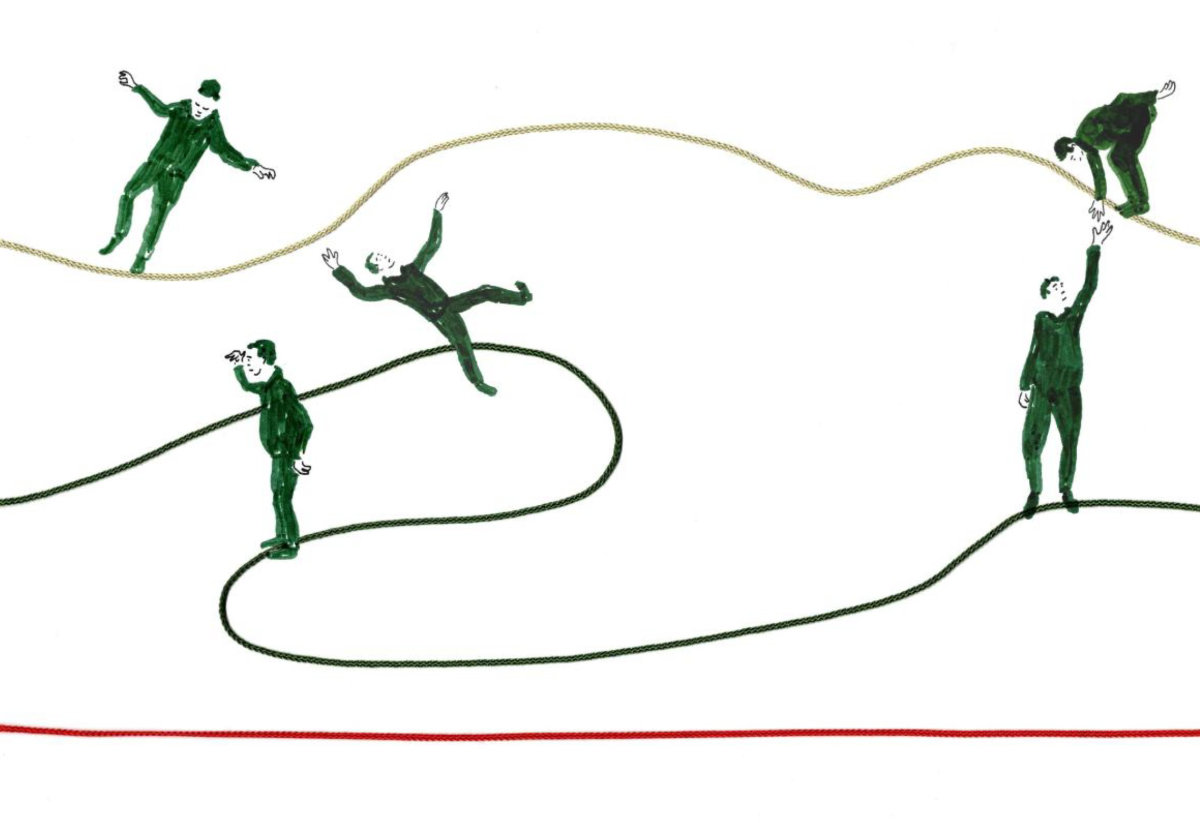
This article is an updated version of the research by Monique van Dongen: Once upon a time… Er was eens… Representation of time in graphic novels and journalistic visual narratives (2025). With a visual translation of the article published on the website of Venster Academy for Illustration and Narrative: Once upon a time… Er was eens… Weergave van tijd in graphic novels en journalistieke beeldverhalen – Venster Academie voor Illustratie & Narratief.
